
DOL industry-driven skills training fund is the focus of this guide because it connects a high-intent search with practical questions about a federal grant initiative that directs funding through eligible state workforce agencies so training can be aligned with employer demand in high-growth and strategically important industries. For readers in Bismarck, ND, the subject matters for more than curiosity. North Dakota construction employers depend on roofers, remodelers, equipment operators, estimators, project coordinators, and other skilled workers who understand safety, materials, weather, and jobsite expectations. A useful article must therefore explain the topic, separate facts from assumptions, and give readers a realistic next step without making unsupported promises.
Rooftop Renovation serves property owners from Bismarck, North Dakota, and Sioux Falls, South Dakota, with roofing, exterior, and remodeling work. The company’s experience provides a local construction perspective, but this article does not imply government, manufacturer, retailer, or sports-venue affiliation where none exists. Bismarck-area construction work is shaped by seasonal scheduling, winter weather, storm response, rural travel, and the need to train workers for practical tasks that cannot be learned from theory alone. That local context helps translate a broad search term into decisions a homeowner, employer, worker, or facility manager can actually use.
This guide covers the meaning of the topic, local relevance, common risks, decision tables, a step-by-step process, practical tips, visual content ideas, and direct answers to frequently asked questions. It also connects readers to the Rooftop Renovation homepage, related services, company blog resources, and the contact page. External sources are linked naturally so readers can verify official program rules and announcements.
What Is DOL Industry-Driven Skills Training Fund and Why Does It Matter in Bismarck, ND?
DOL industry-driven skills training fund can be understood as a federal grant initiative that directs funding through eligible state workforce agencies so training can be aligned with employer demand in high-growth and strategically important industries. The first responsibility is to identify the user’s real intent. Readers may be researching funding availability, checking eligibility, reviewing employer participation, comparing training models, or learning how state workforce agencies administer federal awards.
People in Bismarck, ND need a local explanation because North Dakota construction employers depend on roofers, remodelers, equipment operators, estimators, project coordinators, and other skilled workers who understand safety, materials, weather, and jobsite expectations. Bismarck-area construction work is shaped by seasonal scheduling, winter weather, storm response, rural travel, and the need to train workers for practical tasks that cannot be learned from theory alone.
Related search language includes workforce training grants, skilled trades training, state workforce agencies, and construction workforce development. These phrases clarify the semantic topic without mechanically repeating them throughout the article. The strongest content answers the connected questions behind the keyword: who controls the funds, who can apply, how employers participate, what workers receive, and what outcomes must be documented.
Rooftop Renovation’s role must be stated accurately. The company provides roofing, exterior, and remodeling services. It is not presented as a grant administrator, state workforce agency, training provider, or representative of the U.S. Department of Labor. Its construction experience can offer context about local skills and workforce needs, while official agencies remain responsible for program rules, eligibility, awards, and enrollment.
For primary information, readers should review the official DOL program page and relevant state workforce resources.
DOL Industry-Driven Skills Training Fund Decision Factors
Dol industry-driven skills training fund becomes easier to evaluate when the program is divided into clear responsibilities. Readers often encounter funding headlines before understanding who is eligible to apply and how workers eventually access training. The following table organizes the primary components, their functions, and the practical meaning for employers and workers.
| Component | What It Means | Practical Context |
| Program lead | Eligible state workforce agencies apply for and administer grant funds | Workers generally do not apply directly to the DOL for an individual cash award |
| Industry role | Employers and sector partners identify occupations, competencies, and hiring demand | Training should reflect actual job requirements |
| Training role | Approved providers deliver instruction, work-based learning, or credential preparation | Programs vary by state, occupation, and grant design |
| Participant role | Eligible individuals complete assessment, enrollment, training, and documentation | Local workforce offices explain available pathways |
| Accountability | Grant recipients report spending, enrollment, completion, and employment outcomes | Clear records are essential for public funding |
Dol industry-driven skills training fund research should lead to a specific next action. Workers should contact the appropriate state or local workforce office. Employers should identify real vacancies, competencies, equipment, safety requirements, and advancement opportunities before joining a workforce partnership. Training providers should confirm eligibility and program requirements before advertising grant-supported courses.
A reliable decision begins by identifying the controlling document and the organization responsible for it. Federal program announcements describe the broad framework, while state workforce agencies determine local implementation. Rooftop Renovation can discuss construction workforce needs from an employer or contractor perspective, but official agencies remain responsible for public funding decisions.
Why Choose Rooftop Renovation for Construction Workforce Context in Bismarck, ND?
Dol industry-driven skills training fund deserves a practical and transparent explanation. Rooftop Renovation approaches construction topics from the perspective of real properties, weather exposure, material coordination, safety, scheduling, and customer communication. For Bismarck readers, that perspective helps connect a broad workforce program to actual construction tasks and employer needs.
- Local North Dakota and South Dakota construction context
- Clear boundaries between contractor services and government responsibilities
- Practical understanding of roofing and remodeling occupations
- Evidence-first recommendations using official program information
- Focus on measurable skills rather than attendance alone
- Direct contact path for eligible property services
Rooftop Renovation’s value is not a guarantee that the company can secure funding for an employer or worker. The value is a disciplined construction perspective: identify actual job tasks, required tools, safety expectations, seasonal constraints, physical demands, customer-service skills, and progression opportunities.
Readers can explore residential remodeling services to understand the range of tasks involved in renovation projects. The Rooftop Renovation blog also provides property and construction information that may help workers understand the industry.
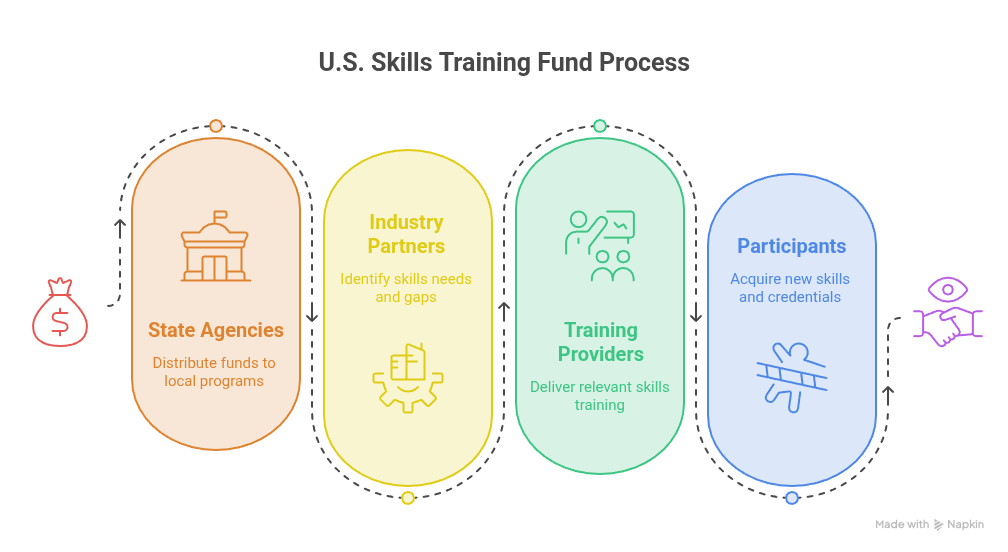
How the DOL Industry-Driven Skills Training Process Works
Dol industry-driven skills training fund is best understood through a repeatable process rather than a quick conclusion. A federal announcement may describe the funding opportunity, but local availability depends on state applications, approved awards, program design, employer partnerships, participant eligibility, and implementation schedules.
Step 1: Federal Program Guidance
The Department of Labor establishes the purpose, eligible applicants, funding framework, priority industries, performance expectations, application rules, and reporting requirements. State workforce agencies review the official notice before developing proposals.
Step 2: State Workforce Planning
Eligible agencies assess labor-market information and identify industries with workforce shortages or strategic importance. The state may consult employers, economic-development organizations, unions, education providers, workforce boards, and community groups.
Step 3: Employer and Industry Participation
Employers help identify job openings, technical competencies, safety expectations, equipment, credentials, work schedules, wages, and advancement opportunities. Industry input should be specific enough to influence curriculum and participant preparation.
Step 4: Training Program Development
Approved providers may offer classroom instruction, work-based learning, registered apprenticeship, on-the-job training, credential preparation, pre-apprenticeship, or a blended model. The program structure depends on grant rules and local workforce needs.
Step 5: Participant Enrollment
Workers generally access the opportunity through state or local workforce systems rather than receiving money directly from a contractor. Eligibility assessments, documentation, career planning, and program availability affect enrollment.
Step 6: Training and Support
Participants complete the required instruction and practical experience. Where rules allow, supportive services may address transportation, childcare, tools, safety equipment, scheduling, or other barriers.
Step 7: Employment and Reporting
Grant recipients track enrollment, completion, credentials, job placement, wages, retention, advancement, spending, and other required outcomes. Employers and training partners may need to provide documentation.
The final program decision should clearly state what is known, what remains uncertain, who is responsible for each step, and when the opportunity is available. Public funding information can change between grant rounds, so readers should confirm details through the controlling agency.
Training Options, Costs, and Requirements
Dol industry-driven skills training fund can support different training pathways. These options may appear similar in a short search result but differ in employer involvement, participant status, instructional structure, cost, duration, and expected outcomes.
| Training Path | Main Strength | Important Requirement |
| Traditional short course | Teaches a defined skill or credential | Best when the credential has recognized employer value |
| Employer-designed cohort | Curriculum is shaped around actual vacancies and equipment | Requires committed employer participation |
| Registered apprenticeship | Combines paid employment and structured instruction | Requires progressive, supervised skill development |
| On-the-job training | Participant learns while working | Employer supervision and measurable competencies are essential |
| Pre-apprenticeship | Builds foundational skills before advanced training | Needs a clear connection to apprenticeship or employment |
| Community college program | Provides formal technical instruction | Curriculum should remain connected to current industry demand |
| Hybrid training | Combines online learning, lab practice, and job experience | Requires careful coordination and participant support |
Dol industry-driven skills training fund comparisons are most useful when every pathway is described at the same level of detail. A short schedule or free course headline can hide eligibility conditions, equipment costs, transportation needs, unpaid time, prerequisite skills, or employer expectations.
Employers should ask what competencies participants will demonstrate rather than focusing only on training hours. Workers should ask whether the program leads to a recognized credential, interview, apprenticeship, paid placement, or documented advancement opportunity.
For local construction services unrelated to grant administration, property owners can request a written scope from Rooftop Renovation and compare equivalent project details before selecting a contractor.
Practical DOL Skills Training Tips
Practical tips for dol industry-driven skills training fund should reduce uncertainty rather than add more terminology. Start with the official program source, identify the responsible state agency, and connect the opportunity to a clear employment outcome.
- Confirm whether the state has an active award or related workforce program
- Contact the state or local workforce agency before promising funding
- Define specific job tasks, tools, safety requirements, and credentials
- Build training around measurable competencies
- Include employer interviews, work experience, or hiring commitments
- Plan participant support where program rules allow
- Keep written records of eligibility, training, spending, and outcomes
Employers should avoid creating a training program that is too broad to prepare participants for actual work. A roofing pathway, for example, may need fall-protection awareness, material handling, measuring, roof-system basics, weather planning, customer communication, and jobsite conduct. A remodeling pathway may require demolition safety, layout, tool use, finish work, moisture awareness, and coordination with other trades.
Workers should verify whether participation creates a debt, requires specific attendance, includes paid work, provides equipment, or leads to a credential. Program staff should explain these details before enrollment.
Construction Workforce Lessons for Bismarck Employers and Workers
Dol industry-driven skills training fund works best when employers describe real tasks and participants can see a clear path from instruction to a job, apprenticeship, credential, or advancement opportunity.
For Bismarck construction employers, training should account for local conditions. Workers may need to operate safely during cold weather, high wind, short daylight hours, storm-repair demand, and travel between urban and rural projects. They also need to understand that construction quality depends on preparation, documentation, teamwork, and communication—not only physical labor.
A roofing trainee may learn how shingles, underlayment, flashing, ventilation, decking, gutters, and weather barriers work together. A remodeling trainee may learn how layout, surfaces, fixtures, flooring, moisture, and finish details interact. Equipment operators and project coordinators need different competency plans.
The safest final step is to use the correct expert. Contact a state workforce agency for an active public program. Contact an approved provider for course details. Contact an employer for job expectations. For eligible roofing, exterior, or remodeling work, use the Rooftop Renovation contact page to request a property consultation.
Frequently Asked Questions About DOL Industry-Driven Skills Training Fund
Dol industry-driven skills training fund generates questions about funding, eligibility, timing, process, requirements, and local access. The following answers are written in direct language for readers and answer engines, but current details should always be verified with the responsible agency.
What is the DOL Industry-Driven Skills Training Fund?
It is a U.S. Department of Labor grant initiative that provides funding through eligible state workforce agencies for employer-informed training in critical and emerging industries.
Can an individual worker apply directly to the Department of Labor?
Workers generally access training through state or local workforce systems. They usually do not apply directly to the DOL for an individual cash grant.
How much funding is available?
Funding depends on the specific grant round, federal appropriation, award amount, and state proposal. Readers should review current official announcements.
Does the program include construction trades?
Eligible sectors and occupations depend on the grant design. Infrastructure, manufacturing, energy, technology, transportation, and related skilled occupations may be included.
How long does training take?
Length varies by occupation, credential, provider, apprenticeship structure, work-based component, and state program.
What should an employer prepare?
Employers should define job openings, competencies, equipment, safety expectations, wages, supervision, credential preferences, and hiring or advancement pathways.
Is Rooftop Renovation a grant administrator?
No. Rooftop Renovation is a local construction company. This content is an informational workforce resource and does not imply government affiliation.
Contact Information
Roof Top Renovation
Bismarck, ND
701-751-7833
info@rooftopnd.com